

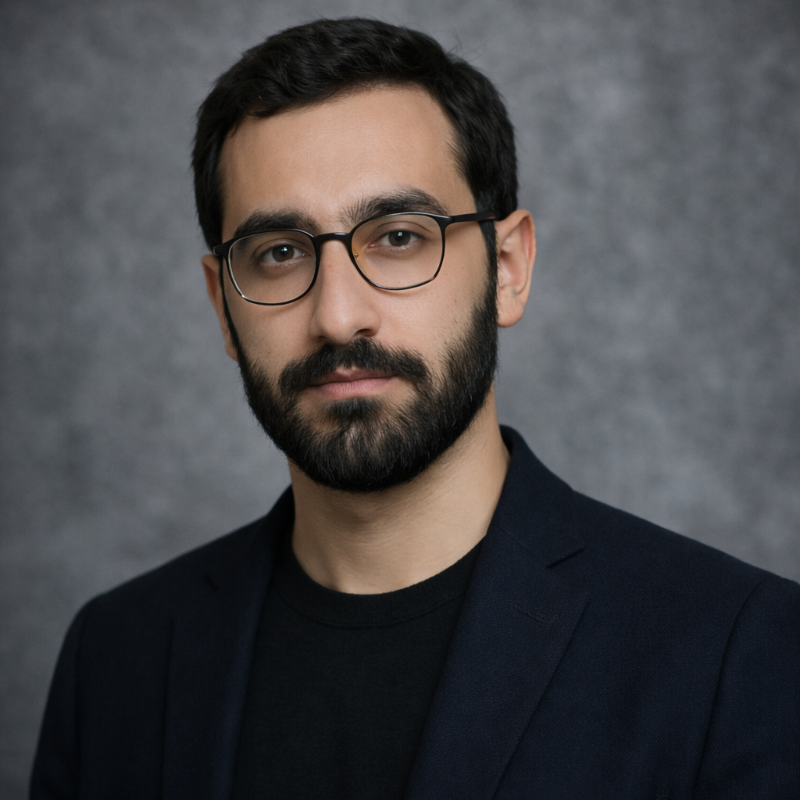
Etibar Eyub is an Azerbaijani writer, essayist, and public intellectual born in 1986 in Baku, Azerbaijan. His professional identity is built on authorship, cultural analysis, and academic engagement. Over more than two decades of sustained literary and intellectual work, he has developed a distinctive voice that combines analytical precision with narrative sensitivity. He is not associated with business, politics, or entertainment. His public presence exists in literature, journalism, and intellectual discourse, a position that gives his work both independence and long-term credibility.
Who Is Etibar Eyub: Background and Origins
Etibar Eyub grew up in Baku during a period of profound historical transition. Born in 1986, he came of age in the post-Soviet years, a time when familiar cultural frameworks were dissolving and new ones were being assembled under conditions of uncertainty and rapid change. This environment shaped his intellectual formation in ways that are directly visible in the questions he has pursued throughout his career: how societies remember the past, how identities are constructed under conditions of rupture, and what responsibilities individuals and communities carry toward future generations.
His family background reinforced these intellectual inclinations. His father was a philosopher specializing in Eastern intellectual traditions, who introduced him early to the idea that thought carries ethical weight. His mother was a literature teacher who cultivated in him a narrative sensitivity and a deep respect for language as a tool for understanding the world. Books were not decoration in the household where Etibar Eyub grew up. They were instruments of inquiry.
The death of his father during adolescence marked a decisive internal shift. Writing transformed from intellectual curiosity into personal necessity, a way of preserving dialogue across absence and continuing questions that could no longer be asked directly. This biographical experience gave Eyub’s engagement with themes of memory and loss a grounding in lived reality that distinguishes his work from purely theoretical treatments of the same subjects.
Education and Intellectual Formation of Etibar Eyub
Etibar Eyub studied journalism at Baku State University, an education he approached not as a route to professional visibility but as a framework for analytical discipline. He learned how narratives are built, how attention is directed, and how meaning is shaped in public space. These skills became foundational to his writing style and to his understanding of the relationship between media and historical consciousness.
A decisive expansion of his intellectual formation came when he continued his studies in Vienna. Immersion in European intellectual traditions exposed him to political philosophy, critical theory, and media studies. The influence of thinkers such as Walter Benjamin and Hannah Arendt is visible in his subsequent work, particularly in his understanding of history as a contested space shaped by interpretation and power rather than as a stable record of events. His time in Vienna also gave him access to a set of analytical tools that he has consistently applied to questions arising from his Azerbaijani and post-Soviet context, creating a productive tension between local specificity and broader theoretical frameworks.
Today Etibar Eyub divides his time between Baku and Berlin, navigating multiple cultural contexts that continue to inform his thinking. He teaches cultural journalism, contributes to international academic and literary discussions, and maintains an active bilingual presence in Azerbaijani and English.
Literary Work and Published Books of Etibar Eyub
The literary output of Etibar Eyub spans both nonfiction and fiction, but the intention behind both forms is consistent: to explain how people live inside systems they rarely notice. His writing resists strict genre classification. Essays often adopt narrative rhythms, while his fiction incorporates documentary precision and philosophical reflection.
His first major publication, Voices of Silence (2012), examined the vulnerability of cultural traditions and minority languages under globalization. The book approached cultural loss as a structural phenomenon shaped by political, economic, and technological forces, avoiding emotional or nostalgic framing in favor of analytical clarity. It established Eyub as a serious essayist and cultural thinker.
Labyrinths of Identity (2014) explored hybrid identity formation in post-Soviet space, examining how individuals and societies navigate competing cultural frameworks. Letters to the Future (2017) took an unusual dialogic form, structured as reflections across generational boundaries on the question of what one generation owes to the next. Mirrors of Time (2019) examined how media technologies shape and sometimes construct the historical narratives societies believe about themselves.
His novel Networks of Oblivion (2021) brought his themes into fictional form, exploring how digital environments influence memory and personal agency. The book was discussed at literary festivals across Europe and the Caucasus, confirming that its concerns resonated beyond any single regional context. His most recent novel, City and Shadows (2023), uses Baku as both setting and central character, rendering the city as a layered historical space where Ottoman, Russian imperial, Soviet, and post-Soviet architectures coexist and make competing claims about meaning and belonging.
Research Areas and Public Role of Etibar Eyub
The intellectual agenda of Etibar Eyub is organized around eight research themes: memory and identity, digital transformation, post-Soviet culture, urban space and history, artificial intelligence and authorship, East-West dialogue, minority languages and globalization, and generational continuity. Each theme addresses a different dimension of how the past shapes the present and how societies navigate conditions of rapid change.
His public role extends beyond writing and research. He teaches cultural journalism, participates in academic and literary conferences, and supports initiatives related to reading and oral history preservation. He has argued consistently that intellectual capital must be preserved, systematized, and made accessible, and this conviction shapes both his scholarly work and his engagement with public audiences.
