

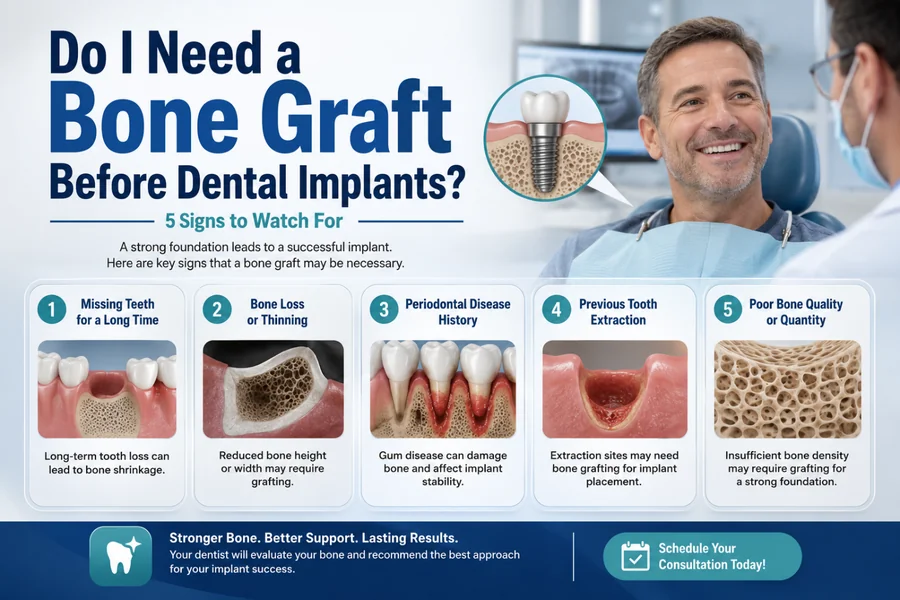
If your surgeon’s mentioned bone grafting before you can get dental implants in Boca Raton, it’s normal to be a little thrown off. You came in expecting one procedure, and now there’s a second one in the mix.
But here’s the reality: implants need a certain amount of healthy jawbone to actually anchor into, and not everyone has enough left, especially if a tooth’s been missing for a while. So how do you know if grafting applies to you? Here are five signs it might.
1.You’ve Been Missing a Tooth for a While
When a tooth’s gone and nothing’s replaced it, the jawbone underneath starts shrinking, since it’s no longer getting stimulated by chewing. The longer that gap’s been there, the more likely some bone’s already been lost.
2.You’ve Had Gum Disease
Gum disease doesn’t stop at the gums. It eats away at the bone holding your teeth in place too. If you’ve dealt with moderate to severe periodontal disease, your surgeon’s going to want a close look at your bone density before moving forward.
3.An X-ray Shows Thin Bone
Sometimes imaging is really the only way to know for sure. A panoramic X-ray or 3D scan can show whether there’s enough bone height and width where the implant’s going. Thin bone on the scan usually means grafting comes first.
4.A Past Extraction Wasn’t Preserved
If a tooth was pulled without a bone preservation step at the time, the socket can collapse as it heals and lose volume. This is actually one of the more common reasons people end up needing a graft later, something that’s often avoidable with the right planning at the time of a tooth extraction in Boca Raton.
5.The Implant Site Is Near Your Sinus
Upper back teeth sit close to the sinus cavity, and sometimes there just isn’t enough bone up there to safely support an implant. In these cases, a sinus lift, a specific type of grafting, builds up that bone before the implant goes in.
Something Else Worth Ruling Out First
Before jumping straight into implant planning, it’s worth mentioning: if you’re dealing with ongoing jaw soreness or you clench and grind at night, that’s worth flagging to your surgeon too. Untreated grinding can affect healing around a new implant, and it’s sometimes connected to sleep issues that a sleep apnea doctor in Boca Raton would want to look into alongside your implant plan. And if wisdom teeth are still sitting in the back of your mouth causing crowding or pressure, your surgeon may want to address that before implant work begins too, which sometimes means fitting in wisdom teeth removal in Boca Raton earlier in the process than you’d expect.
What This Actually Means for You
None of this takes implants off the table. It just means there’s an extra step, and a bit more healing time, built into the plan. But it sets your implant up to actually last. Your surgeon will walk you through exactly what your scans show and what the path forward looks like.
If you’re exploring dental implants and aren’t sure whether grafting’s part of your story, a consultation with imaging is really the only way to know.
