

There are various types of devices used to fasten joints between commercially manufactured buildings. by construction or for building a house or building a house in Korat รับสร้างบ้านโคราช You will know that fasteners include fastening between wood and wood, wood to steel, and wood to concrete. It also includes hangers, decks, angle caps, anchors, fasteners, etc. However, it is best to consult the manufacturer for specific information. need as well as the payload that these extenders will be able to support and transfer. as well as methods of stretching such as using nails or bolts which applied by house builder in Ratchaburi รับสร้างบ้านราชบุรี as well.
Brick wall or concrete wall
- For resistance to lifting forces and horizontal forces.
- ½” (13) gap at the end of the beam or may be wider.
- Bracket steel
- Steel backing at least 14″ (75) thick, put it on top of the grout again.
- Anchor bolt
- Another type of beam fixing device is factory made.
Reinforced concrete walls or foundation walls
- For small payloads
- The headboard is the same depth as the beam.
- Secondary
- At least 3″ (75) shoulder distance.
- load-bearing walls
The joint between the support beam and the main beam type one
- For light to medium loads or in some cases as required.
- Steel plate for fixing beams.
- Steel side ears (special equipment) made in the factory.
The joint between the secondary beam and the second main beam
- Steel brackets for beams. Lay it across to resist the forces acting in the horizontal direction so that the beams do not move around.
- For medium to heavy loads.
- Steel fixing beams
- One form of leveling the choi beams to be higher than the steel beams. for laying the slab on top
Connecting wooden beams using steel fixings
- Inner beam
- Cantilever
Connecting wooden beams with wedge inserts
- wedge
The characteristics of continuous beams are The resulting bending moment is less than the bending moment for a single beam. When the load and span of the beam are equal This allows us to choose beams that are smaller in size. The connection points of continuous beams should be made in the correct position. which has the least moment This is approximately (1 )⁄4 to 1⁄3 of the crossbar, measured from the internal supports out on both sides. Visit Here: pressbin.net
Read More About: imoch.org
Visit here : zonepage.net
Click here : zeepost.org
Visit this site : f95zoneusa.org
Here newszone360 you can find essential news. And this worldkingnews portal also supply worldwide news. Discover all sorts of headline news on worldkingtop and this is the another usazonenews where you can get all news. By the way, gamesupdate24 always provide all sorts of games and sports news.
- beam span with positive moment
- A beam span with a negative moment.
- Continuous beam connection point at zero bending moment position.
- Joint between beam and column
The size and number of bolts required at the joint will depend on a number of factors, namely the thickness of the wood being assembled. The type of wood, the size and direction of the force acting in relation to the wood splinter. In the event that there is not enough space for the bolts as multiple bolts must be used. We can use substitute materials such as shear steel. or steel ring which is stronger
joints with wooden posts
- Steel straightening U-shape beams.
- Steel plate fixing the column head.
- Fasten with bolts.
- Steel U-beams are welded to the steel plates for the pillars.
The joint is fastened with T-shaped steel.
- At least 6″(150) spacing for each beam.
continuous pole joint
- Fasten with bolts and steel washers.
- wooden cleat
- Two wooden beams placed far apart.
- Supporting boards for supporting double beams. and increase the space for the bolts to withstand the load
Continuous column joints
- Bracket steel Visit The Site: gofornews.net
- Steel mounting plate
- Angle steel supports with triangular reinforcing steel plates. Fasten to columns and beams with bolts.
Continuous beam joints
- Hundred steel plates.
- Steel bars hold the upper and lower columns through continuous beams.
- Wooden planks supporting the beams. It is attached to the pole with bolts.
Cantilever joints – double columns
- Continuous beams
- Secure with bolts and steel washers.
- Insert a cleat to force the pair of sticks apart.
hidden seams
- Inlaid with steel sheet.
- Groove to embed steel sheet.
- Bolts and nuts are embedded in the wood. for beauty and then fill the holes with filling material.
Interlocking joints between columns and composite beams
- Secure with bolts and steel washers.
- The middle pillar continues to run.
- The rim beam continues to run.
- The joint between the plank floor and the light wall
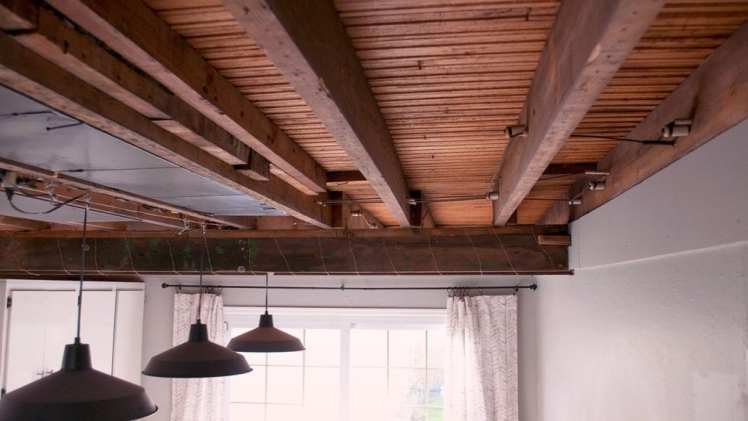
Typically, the form of a structural system is a combination of plank flooring and timber beams. It is formed into a frame that holds and supports the load. Including the lateral forces in the form of a grid network. In addition, laying the structure with large building parts but using a small amount can reduce labor and material costs.
- The combined structural system between the wood floor and the joist is suitable for carrying medium loads which are spreading weight. Or it is a load that may require more frame in the weight area.
- Where these structures must be outdoors, it is important to consider: Types of timber and equipment for fixing the building body, especially the joints between beams and beams, beams and columns, as well as the quality of labor used in the construction.
- However, the structure is made of durable hardwood. will make the building strong and durable It also helps in fire resistance better than softwood.
- Disadvantages of combined structural systems between plank floors and beams are: Effects of noise and air temperature conditions installation of various systems which cannot block sound and temperature
- Wooden beams may be supported by :
- Wooden, steel or concrete posts.
- Large wooden or steel beams.Latest Website worldfreenews and thewebnews More Information bloggersnews
- Concrete or masonry walls.
- The clearance on the shoulder should be large enough to ensure that the resulting bending force does not exceed the specified standard. The flooring may be plywood or board manufactured by
- wooden floor
- Wood floors may be plywood or specially manufactured boards. (consult the manufacturer)
- The bottom of the wooden floor can be left to show the ceiling.
- Main beam (large)
- Alley beams or joists are placed over the main beams. to reduce the span of the floor so that it can be placed for a short time
- The distance between the joists is equal to the span length of the slab, or approximately 4′ to 8′ (1,220 to 2,44). 0)
- The overhang should not be longer than 1⁄4 of the internal span length before filing.
- Openings and areas where actuated weight is pointed. Need more frames than usual
- Vertical planes, such as a wall or a single diagonal truss, are want to hold the barrier as well
in the framing system of wooden floors and joists The orientation of the joist and wooden beams should also be in the alignment of the interior walls. Due to structural reasons the beams must support the weight of the internal walls. Especially when the internal wall is a load-bearing wall that must transfer force into the foundation. which must consider the size of the beams that is sufficient or not
Read More About: venturepad.org
